Stop Furnishing It Like a Patio: The Conservatory Deserves Real Furniture
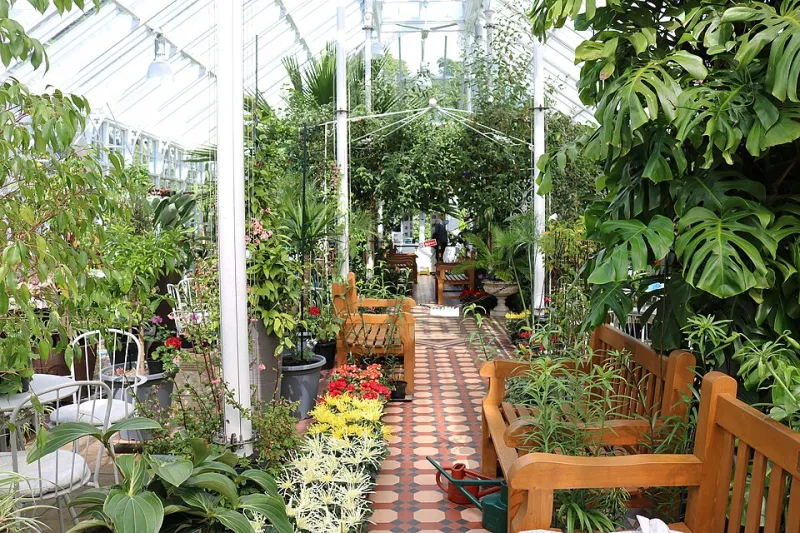
Photo: Billy McCrorie , CC BY-SA 2.0, via Wikimedia Commons
November is the honest month for a conservatory. The garden has stopped being an option, the light is flat by half three, and the room you originally built for long summer evenings has to justify itself as an actual room. Most of them don't. That's rarely a failure of the glazing — it's a failure of what we put inside it.
The room we built and then abandoned
The conservatory boom of the 1980s and 90s left Britain with hundreds of thousands of glass boxes bolted to the back of the house. They were sold as sunrooms, garden rooms, a slice of the Mediterranean, and then furnished accordingly: a rattan suite, a tiled floor, a ceiling fan, and a couple of candles that never got lit. For about six weeks a year, that works. For the other forty-six, you walk through it on the way to the back door and try not to look at it.
The root of the problem is that a conservatory isn't a room in the thermal sense. Glass on three sides and a translucent roof mean it gains and loses heat faster than any other space in the house. In July it's unbearable by eleven; in January the floor is unpleasantly cold and the corners smell faintly of damp. So we stop using it in both seasons, and then we conclude the whole thing was a mistake.
It usually isn't. The fix is to stop treating it as a patio with a roof and start treating it as an interior with a glazing problem. That single change of category does more than any amount of building work.
Choose materials that can survive the swing
A conservatory puts furniture through a cycle of UV, condensation and temperature change that no bedroom ever asks of it. Buy for that reality and the room stops looking tired within two summers.
Solid timber is the safest bet. Teak, iroko or roble cope with humidity far better than any painted softwood, and a painted hardwood frame is fine provided you're willing to touch it up. Skip high-gloss veneers and dark stains, which go patchy and bleached on a south-facing side.
On wicker: natural rattan is a garden material. It dries and cracks in the heat, mildews in the damp, and it's the single biggest reason conservatories look like outbuildings. If you want the texture, look for HDPE synthetic weave on a powder-coated aluminium frame — it will outlast three rattan sets and doesn't care about the swing.
Upholstery wants to be solution-dyed acrylic or a washable poly-cotton with removable, zip-off covers. Nothing deep-buttoned, nothing linen, nothing velvet, and no leather on the sunny side — it cracks, and there's no recovering from it. Cushions should live in a lined blanket box rather than pressed against cold glass, where they pick up condensation and eventually mould.
Metal matters too: powder-coated aluminium and galvanised steel are fine. Untreated iron will bloom with rust in a damp winter without any help.
Low backs, a clear spine, and a view worth facing
Most British conservatories are around three metres by three and a half, with a door at one end and a run of glass on three sides. That shape punishes the obvious layout.
Resist the urge to push everything against the walls. A sofa lined up with its back to the glazing means you sit with a cold draught at your neck and low winter sun in your eyes — nobody stays long in that seat. Instead, float a two-seater perpendicular to the glass, or angle two chairs towards each other, and let the garden wall stay a view rather than something you turn your back on.
Keep the furniture low. Anything above sill height blocks the light that makes the room worth having, and a tall piece in a narrow glass room immediately reads as a corridor with a sofa wedged in it. A couple of low chairs, a small table and a slim console against the house wall will do more than a three-piece suite ever could.
And protect the walking line. If the conservatory is a through-route to the garden, keep 700 to 800mm clear down the middle and accept that it's a room with a path through it, not a lounge that happens to have a door.
The four small interventions that change everything
A tiled floor is cold, hard and instantly outdoor-ish. One large rug — polypropylene, or a wool mix over a decent underlay — transforms the acoustics and the temperature underfoot in a single move. If the floor gets properly damp in the worst weeks, use an anti-slip underlay and lift the rug between December and February rather than pretending it's fine.
Lighting is the second. A single pendant on a glass roof makes the room feel like a canteen. Go warm and layered instead: a floor lamp in the far corner, a table lamp on the console, rechargeable lamps if you can't get a spur out there. Warm white bulbs, and a mirror on the house wall to bounce what little November light there is.
Third, blinds. Pleated roof blinds with a solar-reflective backing do more per pound than almost anything else — they cut summer overheating and hold a bit of warmth in winter. Roman or roller blinds on the vertical glass finish the job and make the room feel enclosed rather than exposed after dark.
Fourth, heat — but honestly. A thermostatically controlled oil-filled radiator or a slim panel heater will take the edge off an evening, and it will cost you. That's the trade: an unheated conservatory is a store; a heated one is a room, and the meter reflects which you've chosen.
When to stop calling it a room
If the frames are leaking, the roof is opaque and the door never closes, no rug will rescue it. In that case, lean in: make it a boot room, drying room or plant room, and stop apologising for it. But if the shell is sound, the furniture is almost always the thing that's wrong.
Here's the test. Sit in it at half four on a grey afternoon with a cup of tea. If you want to leave after five minutes, it needs a rug, a lamp and a chair that isn't rattan. If you're still there at six, it's a room now.