The Van Is Already Outside: Measuring the Sofa Route Through a British Home

You have measured the alcove twice. You have a neat little sketch with wall widths and rug dimensions. Then the van pulls up, the rear doors open, and two delivery drivers look at your front door, then at each other, then back at the sofa. That look is the moment you realise the problem was never floor space. It was the route.
At AD Furniture Journal, we hear this story constantly from UK readers — especially those in flats, Victorian terraces and converted buildings where the front door is more of a suggestion than an opening. So before you tap 'add to basket' on a 2.4-metre three-seater, let's walk the route properly.
The measurement everyone does — and the one that actually matters
Wall width, alcove depth and ceiling height are all useful numbers. None of them tell you whether a sofa can turn ninety degrees in a 90cm hallway. Sofa delivery is not a floor-plan problem; it is a corridor problem. The sofa has to pass through three gates in sequence: the front door, the hallway (including any turns), and the stair bend. Fail one gate and the whole thing stops.
Gate one: the front door
A standard UK front door gives you roughly 76cm to 84cm of clear opening, but older properties can be tighter. Measure the actual clear opening with the door open — not the door slab itself — and include the thickness of the frame, the door handle and any threshold strip. If there is an inner door immediately behind the outer one, measure that too; offset vestibules are a classic flat-block trap.
Gate two: the hallway
Hallway width is usually where things get interesting. Measure the narrowest point between wall and wall, and then check it again at handrail height (around 70cm to 80cm off the floor), because that is where the widest part of an upturned sofa tends to sit. Look for radiators, coat hooks, shoe racks and meter cupboards that shave off a few precious centimetres. A hallway that is 95cm wide at the skirting board can be 80cm wide at the radiator.
Gate three: the stair bend
This is the gate that catches most people. Sofas do not travel up stairs flat and neatly; they travel on their side or on end, pivoting around the bend. You need to measure the width of the stairs between the wall and the banister, the height of the ceiling above the bend, and the diagonal clearance at the turn itself. Pay attention to the newel post — the chunky post at the bottom of the banister — and any bulkhead or lowered ceiling at the top of the stairs. A stairwell can look generous until you add a handrail and a light fitting.
How to measure without guessing
A tape measure is essential, but a cardboard template is better. Cut a piece of card to the height and depth of the sofa's packaged dimensions, then walk it through the route. It sounds daft until you watch a cardboard rectangle jam exactly where the real sofa would. Alternatively, use a long box or a rolled-up duvet taped to the right size. The point is to test the diagonal, not just the straight-on width.
Measure the packaged dimensions, not only the assembled ones. A sofa that is 210cm long in the showroom may arrive in a 220cm box with protective corners. Ask the retailer for both sets of numbers, and ask specifically whether the arms are removable.
Warning signs in period conversions and narrow stairwells
Some buildings are simply awkward, and it helps to know the tells before you fall in love with a sofa online.
- A communal front door with a tight vestibule and an inner door set at an angle.
- A hallway that narrows at the radiator, the coat hooks or the under-stairs cupboard.
- A stair bend with a fixed newel post and a banister that cannot be lifted out.
- A lowered ceiling or bulkhead at the top of the stairs, often hiding pipework.
- A flat door at the top of a communal stair, where the last turn is the tightest.
- A bay-window room where the door is at the side of the room rather than the end, forcing a diagonal turn.
If two or more of these apply, assume you need a sofa that comes apart.
Sofas that can actually be taken apart
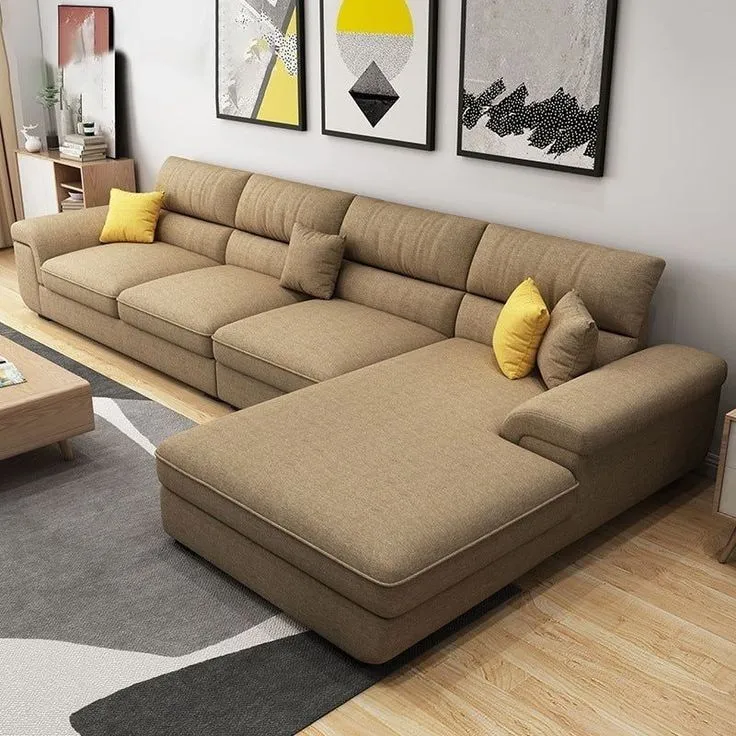
This is where the design of the sofa matters as much as the dimensions. Modular sofas — the kind that bolt together in sections — are the obvious answer for flats and tight hallways, because each piece can be carried separately and assembled in the room. Removable arms are the next best thing: a zip-off or bolt-off arm can shave 10cm to 20cm off the width, which is often the difference between a clean lift and a scratched paintwork saga. Knock-down sofas, where the back and arms detach from the base, are worth considering too, though quality varies — check the frame joints and the guarantee before you commit.
One practical note: sofa beds are usually heavier and bulkier than their fixed counterparts, so if the route is marginal, a standard sofa plus a separate guest bed may be the wiser combination. And if you are set on a large three-seater, consider whether two smaller sofas or a two-seater plus an armchair would give you the same seating with a far easier delivery route.
Before the van arrives
A few small checks make delivery day much calmer. Confirm parking and any permit requirements, especially in London and other controlled zones. Ask whether the delivery team will unpack and remove packaging, and whether they will reassemble a modular sofa in the room. Clear the route in advance — move the coat rack, roll up the runner, take the pictures off the hallway wall. And have a plan B: if the sofa cannot make the final turn, can it be assembled in the hallway and walked in piece by piece?
The short checklist
- Measure the clear opening of every door on the route, not the door itself.
- Measure hallway width at handrail height as well as at floor level.
- Measure stair width, ceiling height at the bend and the diagonal at the turn.
- Test the route with a cardboard template or a box.
- Ask for packaged dimensions, not just assembled ones.
- Check whether the arms are removable and whether the sofa is modular.
- Confirm parking, packaging removal and reassembly before delivery day.
A sofa is a long-term purchase, and the last thing you want is a stand-off on the pavement. Measure the route, not just the room, and the van arriving will be a relief rather than a rehearsal for a return.