The Collected Look: Why a UK Living Room Needs More Than One Wood
Photo: Anthony Vosper , CC BY-SA 2.0, via Wikimedia Commons
There is a certain kind of UK living room that looks expensive but not interesting. Everything matches. The coffee table, television unit, sideboard and nest of tables all share the same honey-oak stain, and the room feels less like a home than a furniture set waiting for a camera crew. Matching is safe. Collected is better.
Mixing wood tones is not a licence to buy every attractive piece you see. It is a design decision based on undertones, scale and texture. Get those three things right and oak can sit beside walnut, painted pieces can soften contemporary finishes, and a Victorian terrace can absorb a modern sideboard without looking like a clearance event.
Read the undertone before the style
Wood has a temperature. Golden oak, reclaimed pine and teak tend to read warm and yellow-orange. Walnut is deeper and browner, often with a plum or chocolate undertone. Ash and pale oak are cooler and quieter. Smoked oak can look grey-brown. Painted furniture is the wildcard: a soft off-white, sage green or inky blue can bridge two woods that would otherwise argue.
Before you buy, take a sample, a drawer or a photo of your floor next to the piece. Look at it in the light of your actual room, not the showroom. North-facing UK rooms can make warm woods look muddy and cool woods look grey. South-facing rooms can make orange pine glow like a chip-shop counter. November light is unforgiving, so test in the evening with your lamps on as well as in daylight.
Choose an anchor piece, then support it
The biggest wood piece in the room sets the tone. In a Victorian terrace, that might be original floorboards or a substantial sideboard in an alcove. In a new-build, it might be a pale oak media unit or a dining table. Treat that piece as the anchor and choose everything else to support it, not compete with it.
A simple ratio helps: around 60 per cent anchor wood, 30 per cent a secondary wood and 10 per cent accent. For example, a walnut sideboard as the anchor, an oak coffee table as the secondary and a painted lamp base or black metal floor lamp as the accent. Or a pale oak dining table with painted spindle chairs and a smaller walnut console in the hallway. The aim is repetition without matching.
Let scale and shape do the talking
Mixed wood schemes fail when every piece is the same visual weight. If your sideboard is chunky, choose a slimmer coffee table. If the dining table is heavy oak, use lighter chairs. If the room is small, one generous piece will often look better than five small ones. A large walnut coffee table can anchor a seating area; a cluster of tiny mismatched tables can make it look like a car-boot sale.
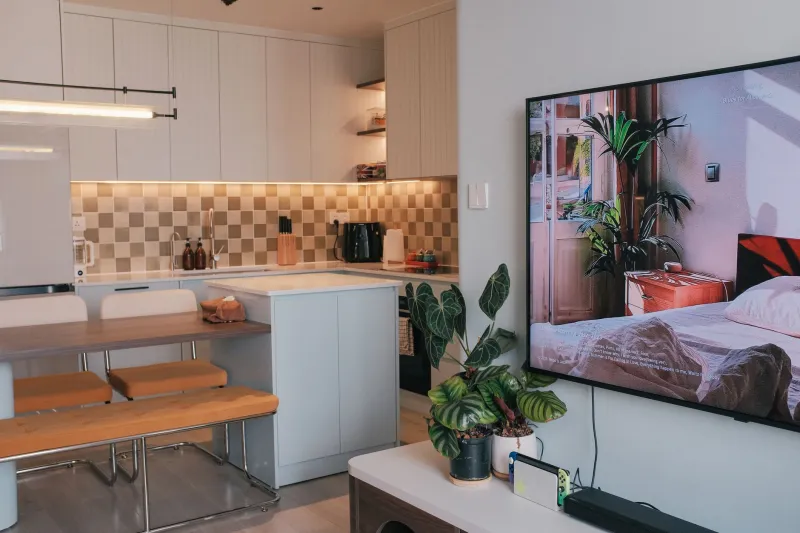
In a period property, use the architecture. Alcove shelving painted in a soft colour can frame a walnut desk or oak sideboard. A bay window can take a painted window seat with an oak stool beside it. In a new-build, where alcoves may be in short supply, a long low media unit in pale oak can ground the room, while a darker walnut nest of tables adds depth without shouting.
Texture stops mixed wood looking flat
Wood is not just colour. It has grain, sheen and age. An oiled oak table has a matte, open texture. A satin walnut sideboard has a quieter sheen. A chalk-painted chair has a soft, powdery finish. Mix those surfaces deliberately. Add linen lampshades, a wool rug, a rattan basket, a glass vase or a blackened metal lamp. These materials act as punctuation.
Be careful with shine. Too many glossy finishes and the room starts to look like a hotel lobby. Too many distressed pieces and it looks like a themed pub. One or two contemporary touches — a smoked-glass coffee table, a slim brass floor lamp, a charcoal painted console — will make the older woods feel more confident, not less.
Two worked examples
In a Victorian terrace with original pine floorboards, the floor is already a warm orange-brown anchor. Keep the walls calm, paint the alcove shelves in a soft green-grey and choose a walnut sideboard for depth. Add an oak coffee table with a pale wash, a linen sofa and a black metal floor lamp. The pine, walnut and oak are all different, but the painted shelves and linen give the eye somewhere to rest.
In a new-build with pale oak flooring, the risk is everything looking washed out. Use an ash media unit to echo the floor, then add a walnut side table and a painted console in a deeper colour. A large wool rug will break up the expanse of floor and stop the woods from floating. One brass or black metal accent lamp will give the scheme a spine. The result is modern but not flat-packed.
The mistakes to avoid
Avoid buying a matching suite and then adding one random antique. Avoid three orange-toned woods in a north-facing room. Avoid placing every piece along the same wall at the same height. And avoid treating painted furniture as a failure — a painted piece is often the thing that makes a mixed wood room feel intentional.
Mixing woods is not about breaking rules for the sake of it. It is about building a room that looks collected over time, even if you bought it all last weekend. Start with one anchor, repeat one tone, add one painted or contemporary note, and let the grain do the rest.